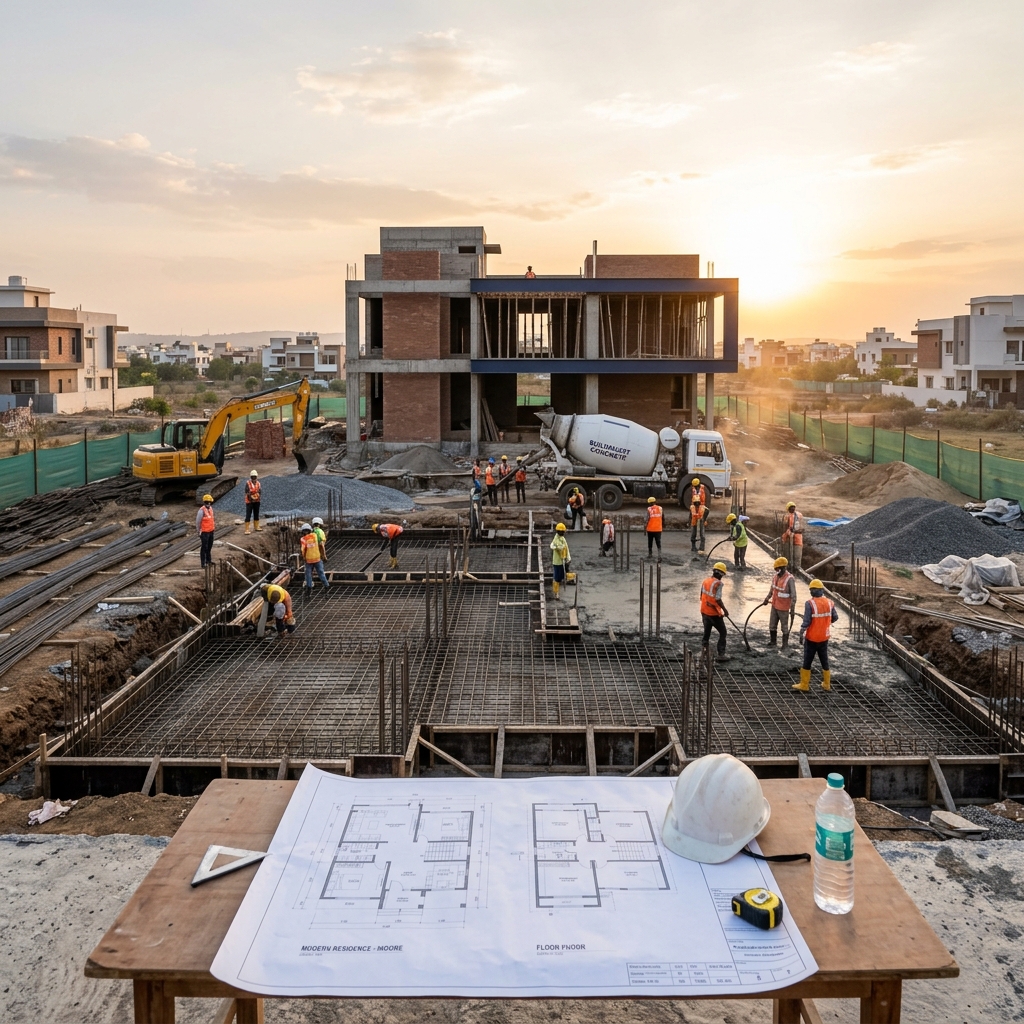
Building a home is a lifelong investment. You select the finest tiles, finalise a beautiful front elevation and plan the perfect interior spaces. But beneath all that visible beauty lies the most important structural element: the foundation. If you choose the wrong foundation for house construction in Indore, your entire investment is at risk of structural failure, wall cracks and uneven settling.
Your plot is unique. What works for a neighbour’s house might fail on your land. Indore’s specific geography, featuring varying soil profiles and moisture levels, demands careful structural engineering. From selecting the correct foundation depth to making sure your main entrance aligns with Vastu principles during excavation, the foundation phase dictates the lifespan of your home.
Whether you are planning a single-storey house or a multi-level luxury residence, the foundation transfers the total load of the building safely into the earth. Let us examine the different types of foundation available and how to identify the exact match for your specific plot.
Why Does Foundation Type Matter for House Construction?
The right foundation for house construction in Indore depends on soil type, plot size and number of floors. Indore's soil profile includes black cotton soil in many zones, requiring raft or pile foundations over isolated footings. Sarovar Builders conducts soil testing before every project. Free consultation: 8889473456.
The foundation is the anchor of your entire home. It holds the building upright, prevents it from sinking into the ground and resists natural forces like earthquakes and strong winds. A correctly designed foundation distributes the weight of the structure evenly across the soil underneath.
If the soil bearing capacity is misjudged, the foundation may settle unevenly. This causes diagonal cracks in your walls, jamming doors and in severe cases, structural collapse. For safety and longevity, structural engineers follow the IS 1904 guidelines set by the Bureau of Indian Standards when designing safe foundations.
When building a home, you also need to factor in the plinth beam. This beam sits at ground level, tying the foundation together and protecting the ground floor from monsoon dampness. It acts as an important barrier between the earth and your living spaces.
Understanding Indore’s Soil: Black Cotton Soil and What It Means for Your Foundation
Black cotton soil is highly expansive, meaning it swells when wet during monsoons and shrinks when dry in summer. This continuous movement can easily crack standard shallow foundations. Homes built on this soil profile require deep pile or raft foundations to maintain absolute structural stability year-round.
Indore and the surrounding Malwa plateau have a high concentration of black cotton soil. This soil type is excellent for agriculture but presents a massive challenge for civil construction. It contains montmorillonite clay, which causes extreme volume changes depending on the moisture content.
During the monsoon season, black cotton soil absorbs water and expands upwards, exerting pressure on the foundation. In the dry summer months, it loses moisture, shrinks and creates deep fissures in the ground. If you place a standard shallow foundation directly on this soil, the movement will inevitably fracture the concrete and tear the walls apart.
To counter this, engineers must bypass the active clay layer. They excavate deeper until they reach a stable stratum, or they design a rigid RCC foundation that floats above the movement. Understanding your specific plot’s soil profile through testing is the only way to prevent disaster.
Type 1: Isolated Footing (Best for G+0 and Light Structures)
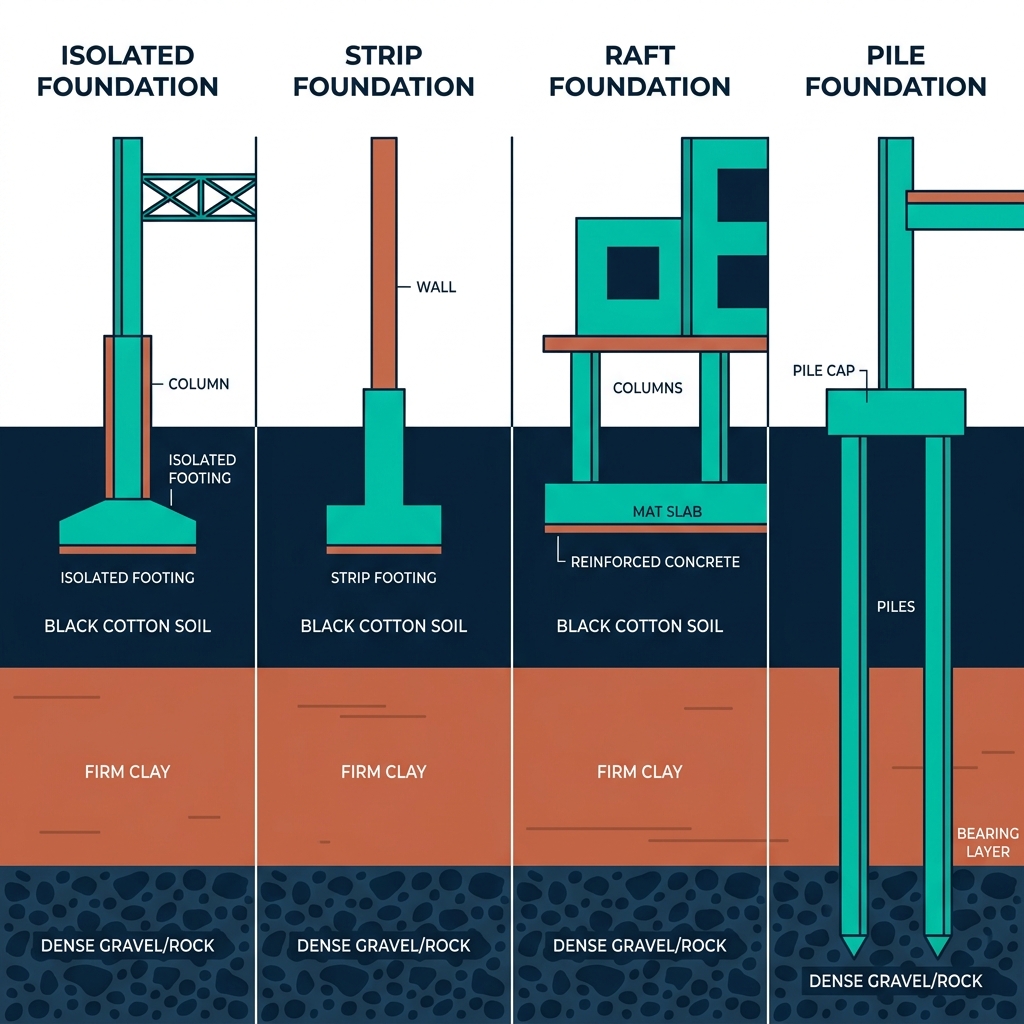
Isolated footing is a shallow foundation type where a separate concrete pad supports each individual column. It is cost-effective and suitable for light structures like G+0 or G+1 homes, provided the soil bearing capacity is high and consistent without expansive clay elements.
An isolated footing, also known as a pad foundation, is the most common shallow foundation used in Indian residential construction. Under every column of the house, workers excavate a square or rectangular pit and cast an independent concrete base. These bases connect to the columns that support the roof slabs.
This type is highly efficient when you have hard, stable soil near the surface. It uses less concrete and steel compared to other methods, keeping your material costs low. However, isolated footings are completely unsuitable for black cotton soil or areas with a high water table.
If you are planning a simple ground-floor home or a small outhouse, isolated footings offer a solid, economical solution. But they offer very little resistance to uneven soil settlement.
Planning a New Home in Indore?
Do not guess your foundation type. Let our structural engineers conduct a proper site evaluation to make sure your home lasts for generations.
Type 2: Strip Foundation (Best for Load-Bearing Walls)
A strip foundation provides a continuous, level strip of support under a load-bearing wall. Builders use this shallow foundation primarily for older architectural styles or boundary walls where the weight distributes across the entire length of the wall rather than concentrating on individual columns.
Before the widespread use of RCC frame structures, most homes in India used load-bearing walls. A strip foundation supports these walls continuously. Instead of digging separate pits for columns, the contractor digs a long trench along the entire wall line and fills it with a wide strip of concrete.
Today, engineers rarely use strip foundations for modern multi-storey homes because RCC columns provide better earthquake resistance and design flexibility. However, strip footings remain relevant for specific applications like heavy boundary walls, retaining walls, or single-storey rural housing.
They require good soil bearing capacity near the surface. If part of the trench sits on soft soil, that section of the wall may sink, leading to stepped cracking in the brickwork above.
Type 3: Raft Foundation (Best for Weak or Expansive Soil)
A raft foundation, or mat foundation, is a thick continuous concrete slab covering the entire footprint of the building. It distributes the total building load over a large area, making it the safest option for weak or expansive black cotton soil where differential settlement is a major risk.
When the soil on your plot is weak or highly expansive, relying on isolated footings is dangerous. A raft foundation solves this problem by turning the entire ground floor area into one massive, rigid structural mat.
Instead of resting the building’s weight on small individual points, the raft spreads the load evenly across the entire plot surface. This drastically reduces the pressure on any single patch of soil. If the black cotton soil shifts or swells, the entire raft moves as a single, solid unit, preventing the columns from moving independently and cracking the walls.
While a raft foundation requires significantly more concrete and steel, the investment is absolutely necessary for safety on difficult plots. For clients undertaking bungalow construction on soft soil, a raft design provides unmatched peace of mind.
Type 4: Pile Foundation (Best for Multi-Storey and Heavy Loads)
A pile foundation is a deep foundation used when the surface soil cannot support the building. Contractors drill deep cylindrical holes and cast reinforced concrete columns deep into the earth until they reach hard rock, transferring the heavy structural load safely past the weak upper soil layers.
For multi-storey apartment buildings, heavy commercial complexes, or homes built on extremely poor soil, a pile foundation is the ultimate solution. When the required foundation depth exceeds the practical limits of open excavation, engineers use specialized rigs to drill deep into the ground.
These deep concrete piles act like underground stilts. They bypass the weak, shifting topsoil completely and anchor the building directly into the hard strata or bedrock deep below. Once the piles are cast, a pile cap connects them at ground level and the building columns rise from there.
Pile foundations are expensive and require heavy machinery, but they eliminate the risks associated with expansive soil. If you are building a four-storey residential property on black cotton soil, pile foundations offer the highest safety factor available in civil engineering.
How to Choose the Right Foundation for Your Plot in Indore
Choosing the correct foundation requires matching your building's total weight against your plot's specific soil bearing capacity. You must factor in the number of floors, local water table depth and soil expansion rates. A professional structural engineer uses a formal soil test report to finalize the exact design.
You cannot select your foundation type by looking at nearby houses. The decision requires precise mathematical calculation. The structural engineer calculates the total dead load of the building materials and the live load of furniture and people.
They then compare this weight against the strength of the soil. If the soil is strong enough, a shallow foundation like an isolated footing works perfectly. If the soil is weak, the engineer will increase the footing size, switch to a raft foundation or recommend deep piling.
Local factors like the water table also influence the choice. If water is present just a few feet below the surface, excavation becomes difficult and special waterproofing measures are needed. Also, many homeowners in Indore align their foundation excavation and main door placement with Vastu principles to make sure positive energy flows from day one.
What Is a Soil Test Report and Do You Need One Before Construction?
A sub-grade soil test report is a mandatory engineering document that details the chemical and physical properties of your land. Geotechnical engineers drill boreholes on your plot, extract soil samples and test them in a lab to determine the exact safe bearing capacity required for foundation design.
Attempting to build a home without a soil test is equivalent to diagnosing a medical condition without a blood test. A sub-grade soil test report is the first and most important document in the construction process.
Engineers use a drilling rig to extract soil samples from various depths across your plot. The laboratory analysis reveals the soil’s load-bearing capacity, its water content and its expansion potential. If they discover a thick layer of black cotton soil, they will immediately rule out isolated footings.
The soil report also determines the chemical composition of the earth. If the soil contains high levels of sulphates or chlorides, the engineer will specify special corrosion-resistant cement to prevent the foundation from degrading over time. Securing this report upfront allows a residential construction company to provide an accurate cost estimate.
Get Absolute Certainty on Your Construction Quality
We provide transparent, structural-safe designs after a thorough site evaluation. No compromises on safety. No mid-project surprises.
When you review your structural drawings, verify that the engineer has optimised the design. An over-engineered foundation wastes materials, while an under-engineered one risks your safety. Working with an experienced design-and-build firm makes sure you get the exact foundation your plot needs, strictly within the guidelines of the National Building Code (NBC) and local RERA regulations.
FAQ
Which foundation is best for house construction in India?
The best foundation depends entirely on the soil test report. For hard, stable soil, isolated footings are the best and most economical choice. For weak or expansive soils like black cotton soil, a raft or pile foundation is the safest option to prevent structural failure.
What type of foundation is used for residential buildings?
Most standard residential buildings (G+1 or G+2) use shallow foundations, specifically isolated column footings. However, if the home is built on challenging terrain or soft soil, engineers will upgrade the design to a continuous raft foundation to distribute the load safely.
How deep should a house foundation be in India?
According to IS code standards, a house foundation should be at least 1.2 to 1.5 meters deep for standard single or double-storey homes on good soil. In areas with expansive clay, the foundation depth must reach past the active soil zone to a stable hard stratum.
Can you build a house on black cotton soil?
Yes, you can build safely on black cotton soil by using the correct engineering techniques. You must replace the top layer of expansive soil with a stable gravel mix and use a rigid raft foundation or drill deep pile foundations to bypass the moving clay entirely.
Why do foundation walls crack?
Foundation walls usually crack due to differential settlement. This occurs when one part of the foundation sinks deeper into the soil than another, often caused by inadequate soil testing, poor compaction, or using the wrong foundation type for the specific plot conditions.
Does the plinth beam count as part of the foundation?
While technically located above the ground level, the plinth beam works in conjunction with the foundation. It ties all the columns together to prevent differential movement and stops dampness from rising from the soil into the ground floor masonry walls.
Need Expert Construction Advice?
Speak directly with our architects and engineers about your specific requirements.
Ready to Start Your Construction Project?
Contact Sarovar Builders for expert construction, interior design and renovation services in Indore.
Get a Free Quote →